
Showing posts with label Java. Show all posts
Showing posts with label Java. Show all posts
Wednesday, November 7, 2012
Java Program to find GCD , LCM of two numbers
Greatest common divisor (gcd)
The greatest common divisor (gcd)( also known as the greatest common factor (gcf), or highest common factor(hcf)) of two or more non-zero integers, is the largest positive integer that divides the numbers without a remainder.
For example, the GCD of 8 and 12 is 4.
Euclid's algorithm
Euclid's algorithm uses a division algorithm such as long division in combination with the observation that the gcd of two numbers also divides their difference.
Formally the algorithm can be described as,
gcd(a,0) = a (1)
gcd(a,b) = gcd(b, a mod b) (2)
Tuesday, November 6, 2012
URI in Java
Before starting with Java.net.URI let us understand first what does URI means in general.
URI (Uniform Resource Identifier) in General
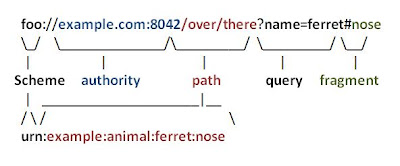
URI (Uniform Resource Identifier) in General
A Uniform Resource Identifier (URI) is a compact sequence of characters that identifies an abstract or physical resource.
The generic URI syntax consists of a hierarchical sequence of components referred to as the scheme, authority, path, query, and fragment.
The following are two examples URIs and their component parts:

Friday, October 21, 2011
Shutdown Hook
Sometimes it is necessary to perform some cleanup before
your java application shuts down. But problem is user may not always exit
properly. User may terminate by pressing Ctrl + C or may simply logoff or
shutdown the Operating system while application is still running.
Well! Java provides an elegant way to execute cleanup code in the middle of shutdown process. We will discuss it in this article.
Let’s start by understanding what happens when JVM (Java Virtual Machine) shuts down!
How to ensure that cleanup code executes in such scenario?
Well! Java provides an elegant way to execute cleanup code in the middle of shutdown process. We will discuss it in this article.
Let’s start by understanding what happens when JVM (Java Virtual Machine) shuts down!
Friday, September 23, 2011
Singleton pattern
Sometimes it’s important for classes to
have exactly one instance.
For example: Although there can be many
printers in a system, there should be only one printer spooler. There should be
only one file system and one window manager.

Singleton
pattern ensures a class only has one instance, and provides a global point of
access to it.
To
implement singleton we need do following two things.
1.
Ensure a
class only has one instance:
This can be achieved by making constructor of a class private ( or protected: In case you want to extend this class.).
This can be achieved by making constructor of a class private ( or protected: In case you want to extend this class.).
2.
Provides a
global point of access to instance:
This can be achieved by keeping static
reference to unique instance and having method to get that instance.
Subscribe to:
Posts (Atom)